
Some technologies emerge every few decades that compel educators to examine what they are actually teaching. For business schools, it's now. In seconds, generative AI can write a marketing plan, review a balance sheet or conduct a negotiation simulation. The traditional format which involves rote learning structures and then reproducing them for exams is getting a lot of pressure. AI in Management Education is NOT a future conversation. It is the challenge of today that influences curricula, classrooms, and careers
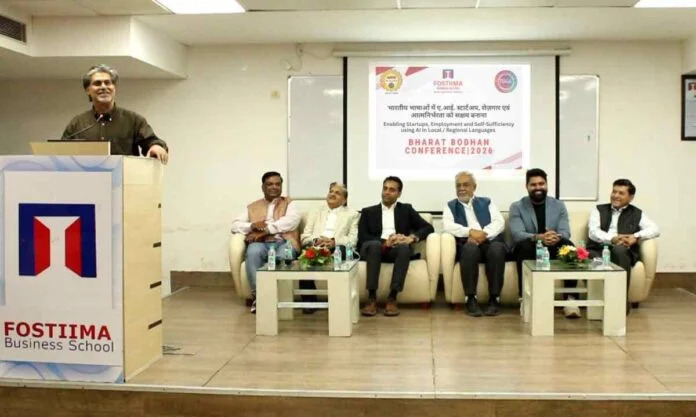
This was what the buzz was all about at the AICTE VAANI Conference organised by FOSTIIMA Business School. AICTE-VAANI scheme (Vibrant Advocacy for Advancement and Nurturing of Indian Languages) provides support to conferences, seminars and workshops conducted on Indian languages in regional languages for the promotion of Indian languages in technical education.
This post condenses the point and the takeaways on the question of where management education is going, for students, faculty and recruiters who want to know
Why AI in Management Education Is Now a Strategic Priority
Management schools for years had technology as one of the many elective courses. This is rapidly no longer the case. No longer are employers asking themselves if a graduate has heard of analytics or automation. They want students to make well-informed decisions with the aid of AI tools the first day of school.
There are three forces at play behind this change:
• Employer expectations. Consulting, banking, FMCG, retail and technology recruiters are all searching for those who can interpret data, challenge AI outputs, and bring human judgment to the mix.
• Tool accessibility. Students are already familiar with chatbots, AI research assistants and automated presentation tools. The institutions that choose to overlook this reality merely put usage out of sight, rendering it out of reach of guidance.
• Pace of change. Syllabi do not age as fast as skills. A curriculum updated on a 3 to 5 year cycle cannot keep up with tools that change on a few month's cycle.
What the AICTE VAANI Platform Means for AI Learning
What should not be forgotten in the discussions about AI is the VAANI scheme. India has over 22 officially recognized languages and a significant number of young managers consider a language different from English as the language they think and learn best in. Many capable learners are left behind when advanced topics such as machine learning, predictive analytics, and algorithmic decision making are taught in English.
As per reports about the launch of the scheme, AICTE Chairman TG Sitharam stated that it will help establish a knowledge base in local languages and foster a wealth of the newest technology knowledge in regional languages. That has real-world implications for AI in Management Education:
1. Wider participation. Smaller communities and regional language backgrounds can be interacted with by faculty and students without language barriers in the concept of AI.
2. Deeper understanding. Understanding of the concepts of bias, probability and limitations in a model is better realized if these concepts are communicated in the learner's best language.
3. Local relevance. When the vocabulary is local, the use cases for AI in the context of a kirana shop, agri-supply chains, regional banking and MSME finance are easier to talk about.
4. Faculty development. Under this scheme, teachers can attend conferences to develop their own AI skills and to exchange techniques with other teachers.
In short, language inclusion and AI readiness are two sides of the same coin. You can't teach AI to half of your talent if you want an AI-able workforce.
Rethinking the Curriculum: From Frameworks to Judgement
What does it matter if you can get a SWOT analysis done in ten seconds with AI when you can still learn it in a management course? The key is judgement – the true goal of management education after all.
Schools that are forward-looking are restructuring their programmes based on several changes:
• Recall to reasoning. The focus of assessment is shifting from questions that can be answered in a paragraph by a chatbot. Students who are able to explain the reasoning behind a recommendation are rewarded by case discussions, live problem-solving, and viva-style defenses.
• Theory-to-tools fluent. Learners will be able to leverage AI in market research, customer segmentation, financial modeling, and content creation, and comprehend the underlying assumptions of each tool.
• From silos to integration. AI isn't just for an Analytics course. A marketing class can study personalisation using AI, a finance class can dig into algorithmic risk scoring, and an HR class can discuss the consequences of AI on hiring and performance appraisal.
• From one to many. Short modules, workshops and certifications enable institutions to update content without having to rewrite any programmes.
The Faculty Question: Teaching the Teachers
If faculty are not on board, there is no possibility of success in curriculum change. The pressure on teachers to become AI experts in a few days or weeks is unrealistic, with many teachers feeling overwhelmed by the need to do so. The goal is AI confidence, not AI mastery.
The good faculty development often has the following components:
• Hands-on practice. AI is explored by teachers in their own content, with sample questions created, quizzes developed, or databases of sample data created.
• Peer learning. Faculty share what was successful and what was not successful. This exchange is naturally facilitated at conferences such as VAANI.
• Clear boundaries. Institutions set boundaries for the use of AI, where it needs to be shared, and where it is not allowed.
• Time and support. Teachers must receive protected time in which they learn. A one-time training without follow-up seldom changes classroom practices.
Ethics, Bias, and Responsible AI: Non-Negotiable Lessons
Having technical skill without morals is hazardous in a manager. The risks are at least as pertinent as the opportunities when it comes to discussing AI in Management Education.
• Hallucinations and accuracy. AI solutions can give answers that are confident but incorrect. One such research conducted by a business school in the UK examined the ability of students to identify factually incorrect answers generated by AI, emphasizing the importance of critical thinking and responsible AI interaction. Future managers should know that they should check first to believe.
• Bias and fairness. A model trained on past data may perpetuate past discrimination in hiring, lending, or pricing. Students should be taught to perform a risk audit of outputs, and who may be negatively effected.
• Data privacy. Filing private client and employee information on public tools can result in legal and reputation exposure. Managers must get the understanding of data governance, and not just productivity shortcuts.
• Academic integrity. Clear policies help. There is a trend towards disclosure, where students can use AI but must specify how, and can explain and defend their work.
• Accountability. An algorithm can suggest, but it is a man who signs it. It may be the most critical ethical lesson to impart to students: Take responsibility for the results of their own efforts, not the "system.
Industry Collaboration and the Skills Employers Want
No management school can be self-contained. That's one thing that AI conferences are important for is that they connect academia and industry.
Employers appreciate the following combination of qualities in new managers in the light of current job market conditions:
• Data literacy: reading dashboards, asking questions about data, and identifying misleading numbers.
• Business storytelling: Analyze then make a clear recommendation for action by leaders.
• Adaptability: learning new tools rapidly as platforms and best practices evolve.
• Ethical thinking: raising awareness of risks before they make the news.
• Human skills: negotiation, empathy, leadership, and teamwork, skills that AI cannot replace.
Conclusion: Preparing Managers for an AI-Shaped Future
The main theme of the AICTE VAANI discussion is hopeful. AI isn't a threat to management education. It emphasizes and strengthens the greatest attributes we can possess: critical thinking, ethical thinking, communication, and decisive leadership. The tools will continue to evolve, but the demand for managers who can skillfully apply them will continue to increase.
With the growth and development of AI in Management Education, such platforms as the AICTE VAANI Conference at FOSTIIMA Business School demonstrate the way academia can unite in creating a true learning benefit and a benefit for the country from a disruptive technology.
Frequently Asked Questions (FAQs)
1. What does AICTE VAANI stand for, and why does it matter?
Vibrant Advocacy for Advancement and Nurturing of Indian Languages. It is an AICTE initiative which facilitates conferences and workshops in regional languages to reach a larger section of learners with technical and management inputs including AI.
2. How is AI changing management education?
AI is changing the idea of memorising frameworks to exercising judgment. Students use AI for research, analysis and drafting, and schools are reengineering their assessment and curriculum to test reasoning, ethics and decision making.
3. Will AI replace management professionals?
Not likely in the short term. AI is transforming jobs, not the job itself. Leaders with ethical judgment, empathy and skill with AI tools will be most in-demand.
4. What AI skills should MBA and PGDM students learn?
Data literacy, effective prompting, basic analytics and visualisation, critical evaluation of AI output, understanding bias and privacy, and converting insights into clear business recommendations are key skills.
5. Is it ethical for students to use AI tools for assignments?
It is subject to institutional policy. The use of AI in school is permitted when done with proper disclosure, provided students can explain and defend their work. If there is no guidance on what should or should not be submitted, and if the output is not disclosed, it is considered an integrity violation.