
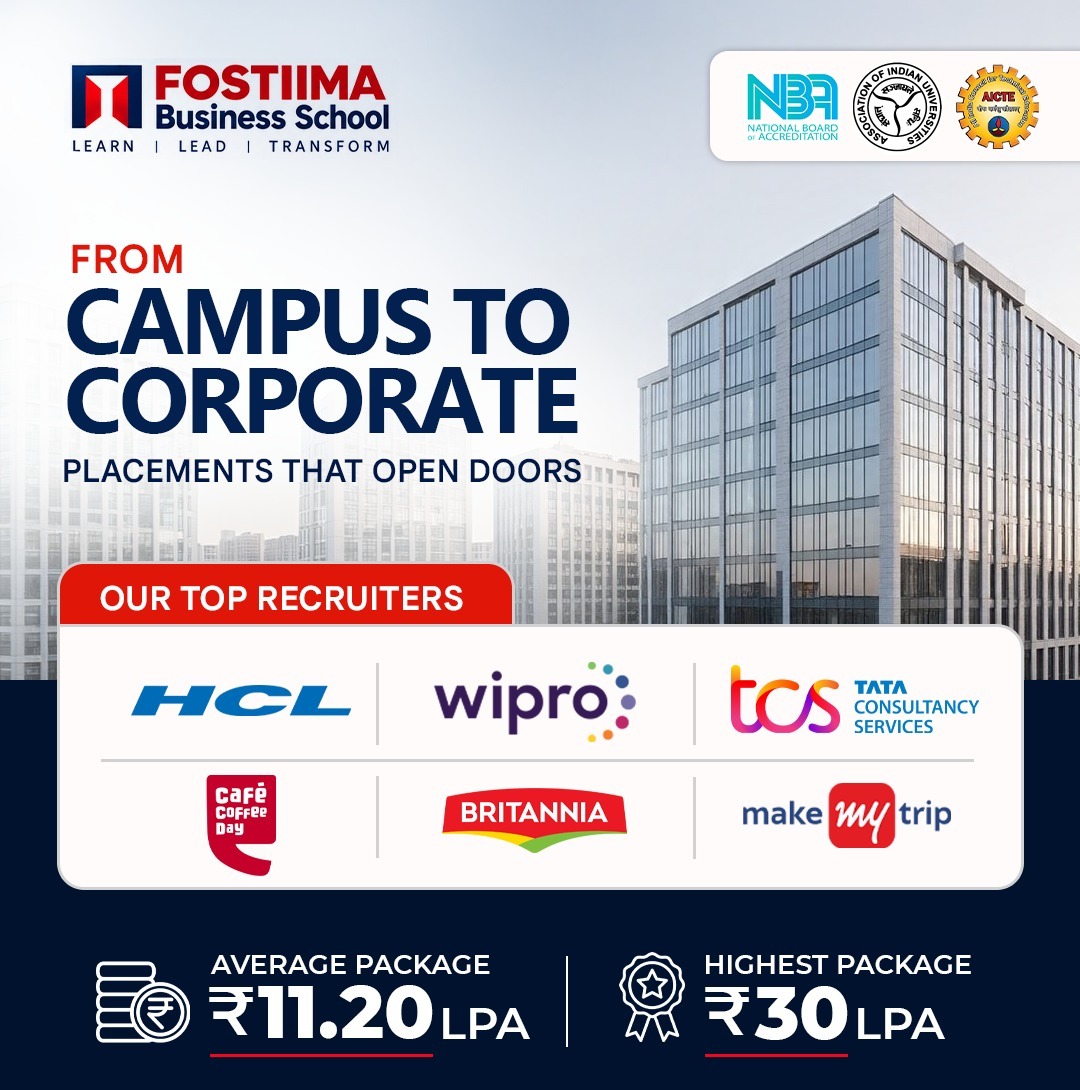
Making such a big decision for your MBA involves making a
choice about where you will attend. Where to study is not the question when the
choice is so many options are available. It is always, “Where will my
investment pay off? While looking for the best MBA colleges in Delhi NCR, you
must have seen that brochures boast about a lot of things – record packages,
global exposure, 100% placements, etc. The truth is that it's not so black and
white.
This guide cuts through
the noise! We also compare fees, placement statistics, and return on investment
(ROI) for area's top institutions and give you tips on evaluating a program
beyond its statistics. When it comes to value for money, think outside the
brand names—the institutes like the FOSTIIMA Business School that specialise in
industry relevant learning and career based outcomes prove it.
Why Delhi NCR Is a Top Destination for MBA Aspirants
Delhi NCR – comprising Delhi, Gurgaon, Noida, and Greater
Noida and Faridabad – is undoubtedly one of the best corporate hubs for
management students in India. Here is why:
• Corporate density.
International consulting companies, banks, FMCG companies, IT giants, start-ups
and multinational companies have their headquarters and large offices in the
region. This translates to increased recruit visits on campuses, internship
opportunities and networking opportunities.
• Industry exposure. Not
only academics, you will find many B-schools here that conduct guest lectures,
live projects and industry mentorship sessions. Students are able to work in an
internship in the morning and have class in the evening.
• Diverse
specializations. The specializations are many from Finance and Marketing to
Business Analytics, HR, Operations, International Business, Entrepreneurship,
etc., and many colleges make changes in the curriculum based on market demand.
• Career mobility. Since
recruiters in Delhi NCR hire for pan India and global opportunities, the MBA
offers opportunities in India and overseas.
The downside to all
those choices is that there is variability in the quality. A few institutes
provide excellent results and other institutes cost high for average results.
It is for this reason that comparing ROI, packages and fees is necessary.
Understanding MBA Fees in Delhi NCR: What You Will Actually Pay
The amount of fees charged for an MBA program is extremely
variable in the region. College availability can be categorized in general into
three categories:
• Premium tier (₹18 lakh
to ₹25 lakh or more for two years). This includes prestigious, brand valued
government or private institutes of excellent reputation like the Faculty of
Management Studies (FMS) Delhi, which may be an exception when it comes to fees.
Premium private institutes like Management Development Institute (MDI),
Gurgaon, Institute of Management Technology (IMT), Ghaziabad, Jindal Global
Business School and Amity Business School fall in this higher range.
• Mid tier (₹8 lakh to
₹16 lakh). Several reputed private institutes are in this list and provide good
placement opportunities without the premium price tag in Noida, Greater Noida
and Gurugram.
• Value tier (₹3 lakh to
₹8 lakh). Quality education on much lesser costs is available in government,
aided institutions and some new private college institutions.
Hidden Costs to Consider
The amount of tuition is only part of the story. Apart from
the above, consider the following while comparing the best mba colleges in
Delhi ncr:
• Hostel/Mess charge
(₹1.5 lakh to ₹3 lakh per year in many campuses)
• The top three cities
to live in are Delhi, Gurgaon, and Noida.
• Books, study material,
and technology costs
• Exchange programs,
international immersions, and certification fees
• Opportunity cost of two
years of salary if you are leaving a job
A ₹12 lakh program with
an average package of ₹8 lakh could generate better ROI than a ₹22 lakh program
with an average package of ₹12 lakh. The cost should not be the only factor
considered.
Placement Packages: Reading Beyond the Highest CTC
All B-schools publish their “highest package” while the
number is generally a one that few students actually get. Smart students do not
take these indicators into account:
• Average package. This is a typical
student's salary. Much more accurate than the best CTC, which may be due to an
outlier or international offers.
• Median package. Better than the average
since it does not have extremes. When a college reports median salary, consider
it a strong indicator.
• Placement percentage. Inquire about the
number of students that chose placement who were offered placement. Also
question the number of students who chose not to participate in the process as
it can skew percentages up.
• Recruiter diversity. Consulting, BFSI, FMCG,
technology and e-commerce recruiters are all present in the right proportion,
indicating a balanced and stable placement scenario.
• Role quality. Do students receive
management trainee, analyst, consultant and product roles, or are they
primarily sales? Role quality influences long term growth.
Indicative Placement Ranges
Overall, the best institutes in the area offer average salaries ranging
between Rs.20 lakh and Rs.30 lakh, and the highest salaries are above Rs.40
lakh to Rs.60 lakh or more. Most of the mid-tier institutes range from ₹6 lakh
to ₹12 lakh, while emerging institutes range from ₹4 lakh to ₹8 lakh. It's
important to not be deterred by a school in the middle. A mid-tier program with
solid industry connections and internship conversion plus mentorship can be a
great value, particularly if students expect to develop skills and advance
rapidly after leaving college
Calculating ROI: A Practical Framework
The best comparison of MBA programs is ROI. One simple way
you can do this is outlined here.
Step 1: Find total
investment. Include on the cost of tuition, hostel, living expenses
and the salary you would have earned in and during the 2 years.
Step 2: Make an
educated guess on post-MBA earnings. Please use an average or a median
package, not the highest.
Step 3: Find your
salary uplift. Calculate the difference between your current salary and
anticipated salary after the MBA degree. As a fresher, make a comparison with
the average pay of a person who has completed a similar course.
Step 4: Estimate the
payback period. Divide total investment by annual salary uplift. Payback
period of 3-5 years is good. After 6-7 years ask the value.
A Quick Example
If your overall package is ₹9 lakh and your pre-MBA salary
is at ₹4 lakh, while the program charges ₹14 lakh for the total fees and living
expenses, then which is more cost-effective?If a program has a total fees and
living expense of ₹14 lakh and your average package is ₹9 lakh and your pre-MBA
salary is ₹4 lakh, which one is more cost effective? If you have an uplift of
₹5 lakhs per year, then you will get a ROI of approximately 2.8 years. This
contrasts with a ₹25 lakh programme which has a baseline of ₹4 lakh and a
package to be paid for of ₹14 lakh. The uplift is Rs 10 Lakhs with the payback
period being 2.5 years. Both programs are good, but the cheaper program is much
less of a financial risk, particularly if you're paying for it with an
education loan.
Keep in mind ROI isn't
just about money. The return is further enhanced by network strength, brand,
quality of learning and career potential over the long haul.
How to Choose the Right MBA College for Your Goals
There are many choices, a plan makes for a confident
decision.
• Define your career
goal first. For consulting and investment banking, brand and alumni networks
are very important. A solid mid-level program with hands-on experience is
really beneficial if you would like to advance in either marketing, operations,
HR or analytics.
• Check accreditation
and approvals. Check for AICTE, NBA or NAAC accreditation and if applicable,
international accreditation like AACSB, AMBA or EQUIS.
• Evaluate faculty and
curriculum. The balance should be between academia and industry. Search for
modern pedagogy based on cases, real life projects, simulation and analytics in
curriculum.
• Speak to current
students and alumni. They will tell you much more about placement support,
quality of classrooms and campus culture than brochures will.
• Review internship
conversion. The conversion rate from internships to PPOs (pre-placement offers)
can be a good indicator of the trust that recruiters place in the institute's
talent pipeline.
• Consider scholarships
and financing. There are merit based scholarships in many colleges, and
education loans are readily available. Consider interest expenses when working
out ROI.
• Visit the campus. Most
students don't realize how much the infrastructure, library, labs and campus
atmosphere will be important over the course of the two years.
Final Thoughts: Choose Value, Not Just a Name
The Best MBA Colleges in Delhi NCR are not just the ones
with the more prominent names or the spectacular highest packages. These are
the ones that align with your career aspirations, are affordable and offer a
realistic and defensible return on investment. Price comparisons, average
placements, median placements, diversity of recruiters, and long-term growth
will be beneficial to you more than rankings.
Whatever you decide to
go for, whether it is the best or the cheapest, do your research, get the
information from official sites and talk to people who have undergone the
program. If you are looking for a business school that offers industry-focused
learning, mentorship and effective career support at a reasonable price,
FOSTIIMA Business School should be on your shortlist and investigated further
with a campus visit or counselling session.
Frequently Asked Questions (FAQs)
1. Which are the best MBA colleges in Delhi NCR?
Typical institutes that
are shortlisted are FMS Delhi, MDI Gurgaon, IMT Ghaziabad, BIMTECH, Jindal
Global Business School, Amity Business School and FOSTIIMA Business School. The
“best” is subjective and depends on your budget, specialization and career
goals; compare them on ROI not only by ranking.
2. What is the
average MBA fee in Delhi NCR?
The fees vary significantly
from approximately ₹3 lakh at government or aided institutes to ₹20 lakh or
even more in the premium private B-schools. The cost of most of the mid-sized
programs are between ₹8 lakh and ₹16 lakh for the entire two-year program.
3. What is a good average
package after an MBA in Delhi NCR?
The best institutes
might give an average of ₹20 lakh or higher; mid-tier colleges would report
between ₹6 lakh and ₹12 lakh. Consider the median as well as the average
package and placement percentage.
4. Is an MBA from
Delhi NCR worth the investment?
Yes, for most students,
if you select a college with a reasonable payback period (usually less than 5
years). The corporate ecosystem is well established in the area, which enhances
the opportunities for internships and work.
5. How do I calculate
the ROI of an MBA program?
Calculate the total
costs (fees, living costs, foregone salary), then divide by the total annual
salary uplift. This result provides you with the payback period. The faster the
payback time, the higher the ROI.
6. Which entrance
exams are accepted by MBA colleges in Delhi NCR?
Popular exams are CAT,
XAT, MAT, CMAT and GMAT. There are also some Universities that have their own
tests and interviews. Review the admission requirements and dates on each college's
webpage.
7. Is it possible to
secure an MBA scholarship or education loan in Delhi NCR?
Yes. Most of the
colleges provide merit and need based scholarships and most of the banks also
offer education loan for MBA course. Read the scholarship policy and loan
tie-ups before applying to each institute.